Revision Rhinoplasty
Revision rhinoplasty is a corrective nose surgery performed after one or more previous rhinoplasty operations. Some patients are unhappy with the shape of their nose, others still cannot breathe comfortably, and many have a combination of both problems. Dr. Mustafa Çakır, as an Otolaryngologist (ENT Specialist) with a special focus on rhinology and nasal surgery, performs revision rhinoplasty to restore support, improve function and create a more natural, balanced appearance.
Revizyon Rinoplasti
Doctor Mustafa Clinic
Revizyon Rinoplasti
Revision rhinoplasty is a corrective nose surgery performed after one or more previous rhinoplasty operations. Some patients are unhappy with the shape of their nose, others still cannot breathe comfortably, and many have a combination of both problems. Dr. Mustafa Çakır, as an Otolaryngologist (ENT Specialist) with a special focus on rhinology and nasal surgery, performs revision rhinoplasty to restore support, improve function and create a more natural, balanced appearance.
What is Revision Rhinoplasty?
In revision rhinoplasty, the goal is to correct or improve the result of earlier nose surgery. Previous operations may have removed too much tissue, left visible irregularities, caused asymmetry, or failed to solve functional issues such as nasal obstruction.
During revision surgery, the internal structures of the nose are carefully re-exposed, scar tissue is managed and weakened areas are rebuilt. This often requires the use of cartilage grafts to support the nasal tip, bridge or valves. The aim is to create a stable nose that looks natural and allows proper breathing for many years.
When is Revision Rhinoplasty Considered?
Revision rhinoplasty may be considered when a patient experiences one or more of the following after previous nose surgery:
Persistent breathing problems, nasal blockage or collapse when inhaling
A nasal tip that looks pinched, droopy or over-rotated
Visible irregularities such as dips, bumps, asymmetry or twist
A nose that does not match the rest of the face or looks “operated”
It is usually recommended to wait at least one year after the last operation before planning revision surgery, so that swelling can fully settle and the tissues can stabilize. This waiting period also helps both the patient and the surgeon see the true final result of the previous surgery.
Consultation with Dr. Mustafa Çakır
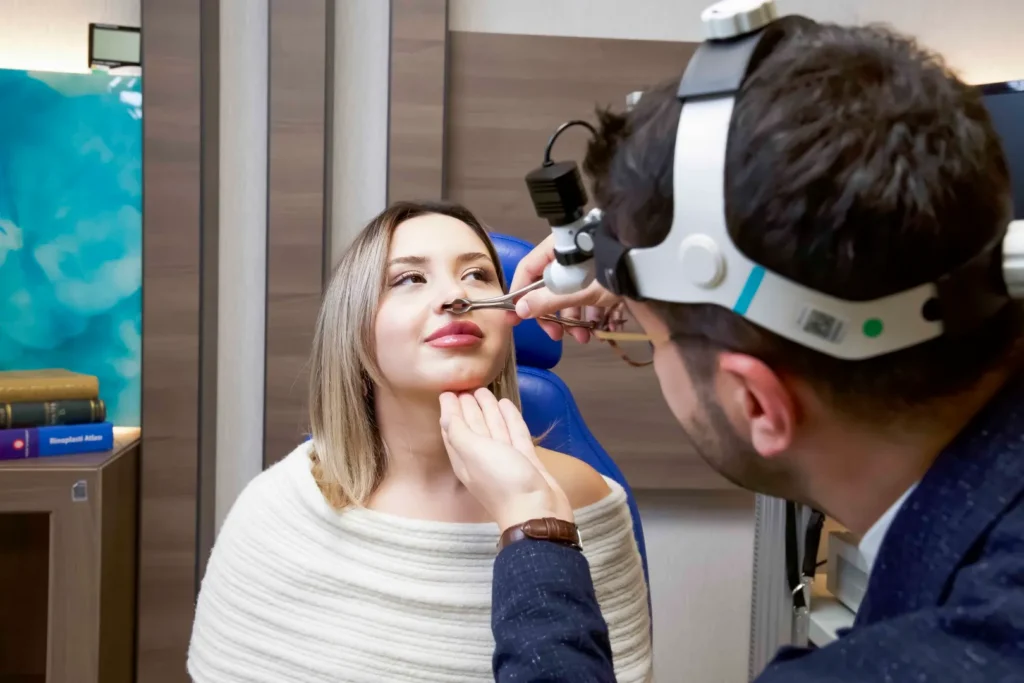
The first step in revision rhinoplasty is a thorough consultation. Dr. Mustafa Çakır begins by listening carefully to the patient’s history: how many operations were performed, what techniques were used if known, and which problems appeared after the previous surgery. Old reports, photos and imaging are helpful when available.
A detailed ENT and nasal examination follows. The internal nasal structures, septum, turbinates and valves are evaluated, and when necessary, endoscopic examination is used. Photographs are taken from multiple angles, and the current shape and function of the nose are analysed. Dr. Çakır then explains what can realistically be improved, what must be prioritized, and which limitations exist because of the previous surgery.
The consultation is an open discussion: patients can ask questions about the procedure, anesthesia, healing time, possible risks and the likelihood of needing further corrections. The goal is for the patient to understand the plan clearly and feel confident about the decision.

Challenges of Revision Surgery
Revision rhinoplasty is more demanding than primary rhinoplasty for several reasons. There is often scar tissue that makes dissection more difficult. Important structures may have been removed or weakened in earlier operations, and the cartilage that was previously available for shaping may no longer be present.
Because of this, revision cases frequently need additional cartilage for rebuilding. The septum inside the nose is used if enough cartilage remains; if not, cartilage from the ear or rib may be considered in selected cases. This reconstructive aspect means the surgeon must think not only about aesthetics, but also about support and long-term stability. For these reasons, realistic expectations and detailed planning are especially important in revision rhinoplasty.
How Revision Rhinoplasty is Performed
Revision rhinoplasty is almost always performed under general anesthesia in a hospital setting. In most cases, an open approach is preferred because it gives better access and visibility to structures that have already been operated on. A small incision is made on the columella, and the skin is gently lifted to expose the underlying framework.
Scar tissue is carefully released so that the bones and cartilage can be seen and reshaped. Areas that are too thin, irregular or collapsed are supported with cartilage grafts. These grafts can help straighten the bridge, define and support the tip, correct valve collapse and restore symmetry. At the same time, functional problems such as septum deviation or turbinate enlargement are addressed to improve breathing.
After the reconstruction and shaping are complete, the incisions are closed, a small cast is placed on the nose, and if needed, soft internal splints are used to stabilize the septum and valves during the early healing phase.
Recovery and Healing Process
The recovery process after revision rhinoplasty is similar to that of primary rhinoplasty, but in some cases swelling can last a little longer because the tissues have been operated on before. In the first few days, it is common to see swelling around the nose and under the eyes, and some patients may experience mild bruising. Pain is usually well controlled with standard medication.
Most patients stay in the hospital for one night and go home the next day. In the first week, it is important to rest, keep the head elevated, avoid heavy physical activity and protect the nose from any impact. Around seven to ten days after surgery, the external cast and any internal splints are typically removed. At this point, many patients feel ready to return to work or daily routines.
Over the following weeks and months, the nose continues to settle. Early changes are visible quite soon, but the final result may take a year or more to fully appear, especially in thick skin or multi-operated noses. Regular follow-up visits with Dr. Çakır help monitor the healing process and address any concerns promptly.
Risks and Expectations
As with all surgical procedures, revision rhinoplasty carries potential risks, including bleeding, infection, delayed healing, prolonged swelling, asymmetry and the possibility of needing further minor corrections. In revision cases, it is particularly important to understand that not every irregularity can always be completely eliminated and that the tissue quality limits what is safely achievable.
Before the operation, Dr. Mustafa Çakır reviews the patient’s general health, medications and previous surgical history, and may request additional tests if necessary. He explains the risks and limitations clearly and sets realistic expectations about the degree of improvement that can be reached. The aim is always to maximize both function and appearance, while keeping patient safety and long-term stability as the highest priority.